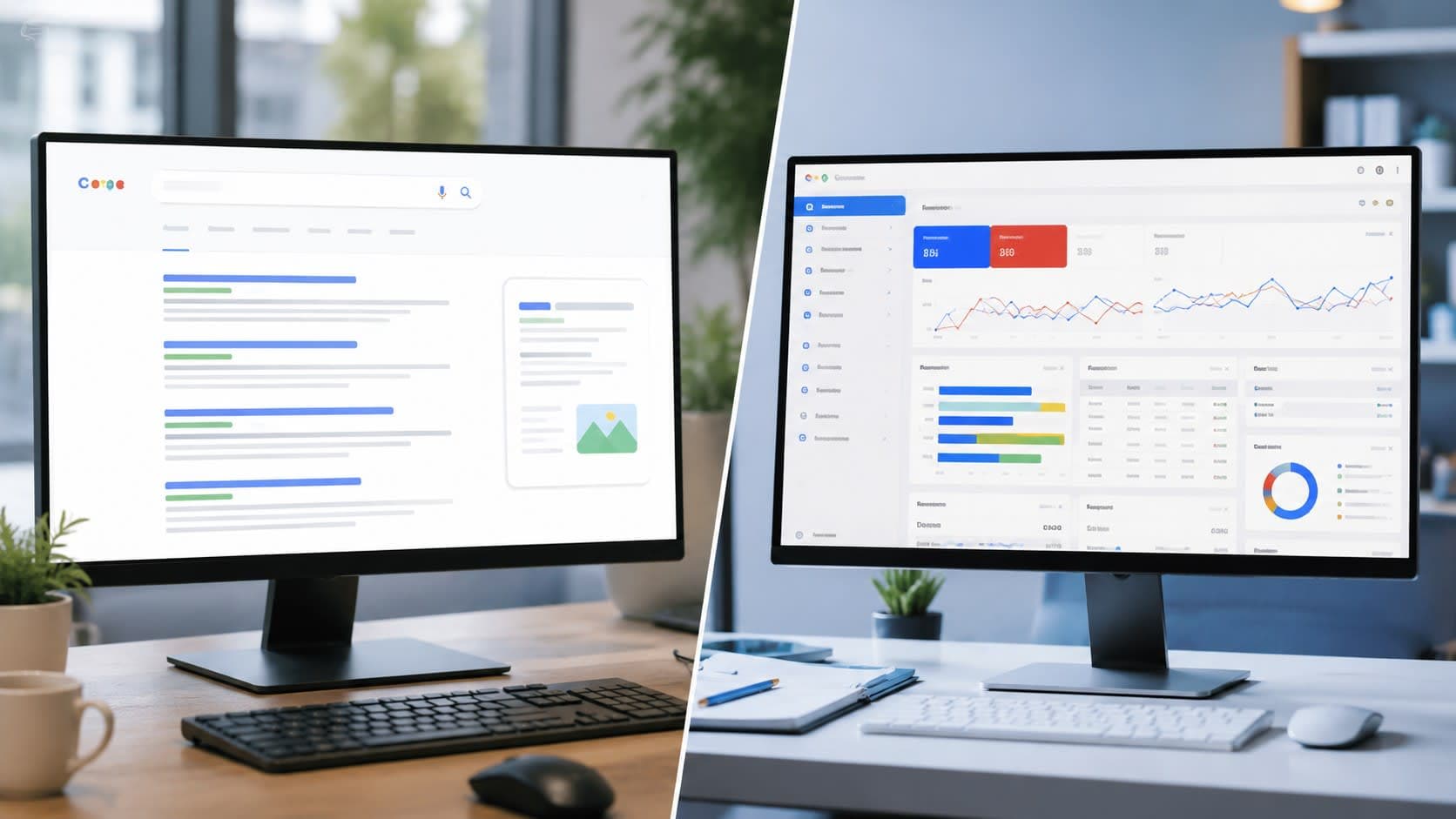
Google Ads vs SEO: Which Is Better for Your Business in 2025?
MarketiXpert Team
13 May 2026 • 05 Mins read min read
One question dominates almost every new client conversation we have:
"Should I invest in SEO or Google Ads?"
The honest answer: it depends on your timeline, budget, industry, and goals. But there's a framework for making the right call — and most businesses get it wrong by defaulting to the wrong channel for their situation.
This guide gives you the full comparison so you can decide with confidence.
The Core Difference: Renting vs. Owning
The single most important distinction between Google Ads and SEO:
Google Ads is renting visibility. SEO is building an asset.
With Google Ads, you pay for every click. The day you stop paying, the traffic stops. You're renting space on the results page.
With SEO, you invest in building a permanent presence. Rankings earned through quality content and links continue driving traffic long after the work is done. You own the position.
Neither is universally better. Both have their place. Understanding the distinction is the starting point for making the right choice.
Google Ads: When It Makes Sense
Advantages of Google Ads
Speed: Campaigns can go live within 24–48 hours of setup. You can drive traffic today.
Predictability: With enough data, you can predict cost-per-lead fairly accurately. Budget in, leads out.
Targeting precision: Target by keyword, location (down to postal code), device, time of day, audience demographics, and even customer income level.
Immediate testing: Test new markets, products, and messaging quickly without waiting months for SEO to validate an idea.
High-intent traffic: Search ads appear exactly when someone searches your target keyword — they're ready to buy right now.
Disadvantages of Google Ads
Ongoing cost: Every click costs money. Stop paying, stop getting traffic. There's no residual value.
Competition drives up costs: In competitive industries (legal, home services, financial services), CPCs can reach $20–$100+ per click. A 2% conversion rate means $1,000–$5,000 per lead before management fees.
Ad blindness: A growing percentage of searchers scroll past ads. Organic results still get 65–75% of total clicks.
Needs expertise to be profitable: A poorly managed Google Ads account burns budget fast. Most small businesses running their own ads waste 40–60% of spend on irrelevant searches.
When to Choose Google Ads
- You need leads or sales immediately (new business, seasonal campaign, product launch)
- Your average customer lifetime value is high enough to justify $50–$200+ cost-per-lead
- You're in a competitive market where SEO will take 12+ months to deliver results
- You want to test whether a new service or geographic market has demand before investing in long-term SEO
- You've already invested in SEO and want to capture every high-intent search while waiting for rankings to improve
SEO: When It Makes Sense
Advantages of SEO
Compounding ROI: Unlike ads, SEO value compounds over time. A page that ranks well in year 2 costs the same to maintain as it did to build — but keeps driving traffic.
No cost per click: Once you're ranking, organic traffic is free. A page driving 1,000 visitors/month costs nothing on a per-click basis.
Trust and credibility: Studies consistently show that users trust organic results more than paid ads. This is especially true in high-trust categories like healthcare, legal, and financial services.
Competitive moat: Strong SEO is hard to copy quickly. A competitor can launch a Google Ads campaign overnight, but they can't replicate 3 years of content and link equity in 3 months.
Captures the full funnel: SEO can reach customers at every stage — from early research ("how does X work") to ready to buy ("hire X in [city]"). Google Ads typically only captures bottom-of-funnel searches efficiently.
Disadvantages of SEO
Time: Meaningful results typically take 3–6 months for competitive terms; 6–12+ months for highly competitive industries. This is a real cost if you need leads now.
Unpredictability: Algorithm updates can affect rankings. Google changed its algorithm 5,000+ times in 2023 alone. Good SEO is resilient but not immune to fluctuations.
Content investment: Effective SEO requires ongoing content creation, which requires time, expertise, or budget.
Technical complexity: Enterprise sites with thousands of pages require significant technical SEO resources to maintain.
When to Choose SEO
- You're playing a long game and can wait 4–8 months for initial results
- Your business has been running for 6+ months and you need sustainable growth
- You're in an industry where trust matters (healthcare, legal, financial) and organic rankings carry more weight
- Your average sale value is relatively modest (ads may not be cost-effective at $50+ CPC)
- You want to build a marketing channel you own, not rent
Head-to-Head Comparison
| Factor | Google Ads | SEO |
|---|---|---|
| Time to first results | 24–48 hours | 3–6 months |
| Ongoing cost | Per-click payment forever | Content + maintenance only |
| Traffic when paused | Stops immediately | Continues |
| Trust level | Lower (labelled "Ad") | Higher (organic) |
| Best for tight timelines | ✓ | ✗ |
| Long-term ROI | Diminishing | Compounding |
| User click share | 25–35% | 65–75% |
| Targeting precision | Very high | Moderate |
| Competitive moat | Low | High |
| Algorithm risk | Low | Moderate |
The Real Answer: Use Both
For most established businesses, the optimal strategy is SEO as the primary long-term channel + Google Ads to fill the gap while SEO builds.
Here's how it works:
Month 1–3: Run Google Ads to generate immediate leads. Use the conversion data to identify which keywords convert best — this informs your SEO content strategy with real data rather than assumptions.
Month 3–6: SEO starts generating results for lower-competition keywords. Reduce ad spend on terms where you're now ranking organically. Reinvest into harder terms.
Month 6–12: Strong SEO presence for most target keywords. Use Google Ads for competitive terms that haven't ranked yet, for seasonal campaigns, and to dominate the full SERP (appearing in both ads and organic).
Month 12+: SEO is your primary revenue channel. Ads are a complement — high-intent brand terms, competitor keywords, and new product launches.
This approach gives you immediate revenue (ads) while building a permanent asset (SEO) that reduces your cost of customer acquisition over time.
Budget Allocation Guidelines
For businesses with limited marketing budgets, here's a framework:
Under $1,500/month total budget: Start with SEO only. Google Ads at this budget level rarely generates enough data to optimize effectively in competitive markets.
$1,500–$3,000/month: 70% SEO / 30% Google Ads. SEO for long-term growth; small ads budget for immediate leads on your top conversion keyword.
$3,000–$7,500/month: 60% SEO / 40% Google Ads. Solid ad budget to drive leads while SEO builds; aggressive content creation.
$7,500+/month: Split based on your specific goals and market. Most businesses at this level maintain both aggressively.
Industry-Specific Recommendations
Law firms: SEO builds the trust that converts legal clients; CPCs are very high ($30–$100+). SEO-first with targeted ads for immediate intake.
Home services (HVAC, plumbing, etc.): Google Ads and Local Services Ads are essential for same-day emergency searches. SEO critical for non-emergency research traffic.
Healthcare: Organic search dominates in healthcare — patients research extensively before choosing a provider. Strong SEO is table stakes.
E-Commerce: Both are essential. SEO for category pages and informational content; Google Shopping for product discovery.
B2B / SaaS: SEO for thought leadership and organic pipeline; LinkedIn Ads more effective than Google Ads for complex B2B sales.
Restaurants / Local retail: Local SEO and GBP are far more valuable than paid search for most restaurants. Focus there first.
The Bottom Line
- Need leads this month? → Google Ads
- Building for 12 months from now? → SEO
- Have the budget? → Both, in the right proportion
The biggest mistake businesses make is picking one and ignoring the other entirely.
The second biggest mistake is starting Google Ads without proper conversion tracking — you'll never know if it's working.
Get a free SEO audit → | Talk to us about your marketing mix →
Related: How Long Does SEO Take? | How to Choose an SEO Agency
Building a Winning Startup Culture: A Founder's Guide
Building a startup is a marathon, not a sprint, and the culture you cultivate is the engine that powers your team through every mile. As founders, we're often so focused on product-market fit, funding...
From Zero to Traction: A Founder's Guide to Startup SEO in 90 Days
Starting a new venture is exhilarating, but gaining initial visibility often feels like shouting into a void. For many founders, a robust online presence is non-negotiable, and that means mastering **...